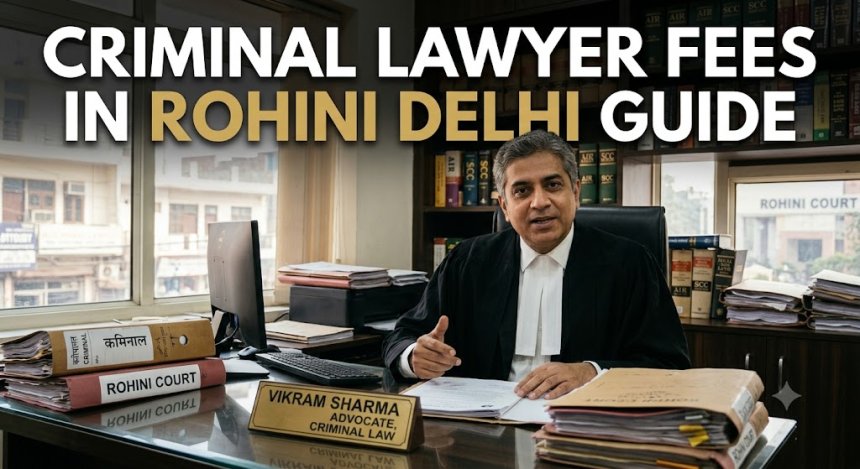
Criminal Lawyer Fees in Rohini Delhi Guide
Understand criminal lawyer fees in Rohini, Delhi. Learn court costs, bail charges, billing models, and practical tips before hiring an advocate

⚖️ HOW LONG WILL YOU STAY SILENT?
📞 Call Karke Advocate Ko Apni Legal Problem Batayein.
Poochhne Mein Koi Nuksan Nahi Hota.
Ek Baatcheet Aapko Sahi Kanooni Disha Dikha Sakti Hai.
Speak to a Supreme Court Advocate Today.
Talk or Message in Any Language.
⚖️ HOW LONG WILL YOU STAY SILENT?
📞 Call Karke Advocate Ko Apni Legal Problem Batayein.
Poochhne Mein Koi Nuksan Nahi Hota.
Any Language Supported
Criminal Lawyer Fees in Rohini, Delhi: Practical Costs, Court Process & Hiring Guide
Facing a criminal complaint or sudden police investigation is one of the most stressful experiences a person or family can encounter. When an FIR is registered or a summon is issued from the Rohini District Court, the first and most urgent question is almost always practical: How much does a criminal lawyer charge, and what are the actual costs involved in defending a case?
Legal expenses in criminal matters are often misunderstood. Clients frequently hear conflicting estimates, encounter unexpected clerkage or drafting costs, or struggle to evaluate whether an advocate's quote reflects standard market practice. Understanding how Criminal Lawyer Fees in Rohini, Delhi work—alongside the actual procedural stages in the District Court—enables you to plan your defense strategically without falling into common financial or procedural traps.
Understanding the Problem: Why Legal Fee Ambiguity Exists
Unlike statutory government services or standardized corporate filings, criminal defense representation does not have a single, fixed statutory tariff mandated by law. In practice, legal fees across North and North-West Delhi (including areas like Rohini Sectors 1 to 24, Pitampura, Prashant Vihar, Mangolpuri, and Shalimar Bagh) vary widely depending on the nature of the allegations, the stage of legal intervention, and the forum involved.
Common Situations That Lead to Urgent Legal Hiring
-
Sudden Arrest or Custody Threat: An urgent requirement for Anticipatory Bail or Regular Bail under criminal procedure laws.
-
Matrimonial and Domestic Allegations: Registration of FIRs involving Sections 85/86 of the Bharatiya Nyaya Sanhita (BNS) (formerly Section 498A IPC) or proceedings under the Protection of Women from Domestic Violence Act.
-
Financial & Cheque Bounce Matters: Complaints filed under Section 138 of the Negotiable Instruments Act or allegations of cheating/criminal breach of trust (Sections 316/318 BNS).
-
Quashing Petitions: Seeking to quash false or settled FIRs directly before the Hon’ble High Court of Delhi.
-
Full-Scale Criminal Trials: Multi-year defense involving chargesheet scrutiny, witness cross-examination, and final arguments.
Real-Life Example
Consider a small business owner residing in Pitampura who was named in a commercial cheating complaint registered at the Prashant Vihar Police Station. Believing the matter was merely civil, he ignored initial police notices. When the police threatened custodial interrogation, the family rushed to Rohini Court and hired an advocate based solely on the lowest initial quote.
The engaged advocate drafted an incomplete anticipatory bail application without annexing essential ledger sheets and bank statements. The application was dismissed at the Sessions level, forcing the client to approach the Delhi High Court at three times the original cost under severe time constraints. Clear upfront knowledge of procedural stages, documentation standards, and advocate fee structures prevents such costly missteps.
What Does Indian Criminal Law Say?
Criminal defense and court procedures in India are governed by substantive, procedural, and evidentiary statutes. With recent legal reforms, criminal proceedings initiated on or after July 1, 2024, fall under updated statutory frameworks:
-
Bharatiya Nyaya Sanhita, 2023 (BNS): Replaced the Indian Penal Code (IPC), defining criminal offenses, their ingredients, and statutory punishments.
-
Bharatiya Nagarik Suraksha Sanhita, 2023 (BNSS): Replaced the Code of Criminal Procedure, 1973 (CrPC). It outlines procedures for FIR registration, police investigation, arrest, remand, regular bail (Section 480 BNSS), anticipatory bail (Section 482 BNSS), and trial conduct.
-
Bharatiya Sakshya Adhiniyam, 2023 (BSA): Replaced the Indian Evidence Act, 1872, governing the admissibility of electronic records, primary/secondary evidence, and witness examinations.
-
Special Acts: Depending on the charges, laws such as the Negotiable Instruments Act (NI Act), Information Technology Act (IT Act), Narcotic Drugs and Psychotropic Substances Act (NDPS), and Protection of Children from Sexual Offences Act (POCSO) apply specific statutory bars and procedural rules.
Under Indian law, an accused is presumed innocent until proven guilty beyond reasonable doubt, and legal representation is a constitutional right under Article 22(1) of the Constitution of India. However, the operational expenditure of private defense—drafting, appearances, cross-examinations, and legal research—is mutually agreed upon between the client and the engaged advocate.
Step-by-Step Legal Process in Criminal Matters
Understanding the legal lifecycle of a criminal matter in the Rohini District Court helps you understand why fees are structured stage-by-stage rather than as a single lump-sum event:
[Police Notice / FIR]
        │
        ▼
[Pre-Arrest / Anticipatory Bail (Sessions Court / High Court)]
        │
        ▼
[Arrest / Remand Hearing -> Regular Bail (Magistrate / Sessions)]
        │
        ▼
[Police Investigation -> Filing of Chargesheet / Police Report]
        │
        ▼
[Scrutiny of Documents & Framing of Charges / Discharge Application]
        │
        ▼
[Prosecution Evidence (Examination & Cross-Examination of Witnesses)]
        │
        ▼
[Statement of Accused & Defense Evidence]
        │
        ▼
[Final Arguments & Judicial Verdict / Appeal]
Stage 1: Police Inquiry and Notice Compliance
Before an arrest or formal chargesheet, police authorities may issue notices requiring attendance during investigation. An advocate assists in drafting replies, ensuring protection against self-incrimination, and exploring pre-litigation resolution if compoundable.
Stage 2: Bail Proceedings (Anticipatory or Regular)
If there is an apprehension of arrest, an application for Anticipatory Bail is filed before the Sessions Court at Rohini. If the person is already detained, a Regular Bail application is presented before the concerned Metropolitan Magistrate or Additional Sessions Judge.
Stage 3: Filing of Chargesheet and Scrutiny of Documents
Once the police complete the investigation, they submit a Final Report (Chargesheet). The court supplies copies of the chargesheet, witness statements, and relied-upon documents to the defense under the BNSS.
Stage 4: Arguments on Charge or Discharge
The defense advocate evaluates the chargesheet to argue for discharge if the allegations do not fulfill the statutory ingredients of the offense. If prima facie grounds exist, the court formally frames charges.
Stage 5: Trial and Cross-Examination (Prosecution Evidence)
This is the core of criminal litigation. The prosecution produces its witnesses. The defense advocate conducts cross-examinations to dismantle contradictory testimonies, test credibility, and extract material facts favorable to the accused.
Stage 6: Defense Evidence and Final Arguments
The accused presents their defense evidence, followed by exhaustive legal arguments on facts, statutory provisions, and binding precedents of the High Court and Supreme Court.
Stage 7: Judgment and Post-Trial Remedies
The court pronounces either an acquittal or a conviction. In the case of conviction, arguments on the quantum of sentence take place, followed by appeals before the High Court of Delhi.
Documents Required for Criminal Defense
Having organized, legible documentation reduces drafting turnaround time and enables your advocate to identify grounds for discharge, bail, or quashing early.
| Category | Documents | Purpose / Legal Relevance |
| Mandatory Documents |
• Copy of FIR / Police Complaint
• Arrest Memo / Remand Order (if in custody)
• Summons / Warrants issued by Court
• Identity Proof of Accused & Sureties (Aadhaar/Voter ID) |
Establishes the exact charges, jurisdictional court, custody status, and bail eligibility. |
| Supporting Evidentiary Documents |
• WhatsApp chats, emails, call records
• Bank account statements / Transaction receipts
• CCTV footage or digital logs (with required electronic certificates)
• Proof of alibi (travel tickets, attendance logs) |
Rebuts prosecution claims, establishes false implication, and proves absence from the scene of crime. |
| Property / Solvency Documents (For Bail) |
• Original Title Deeds / Electricity Bills
• RC of vehicles / Fixed Deposit Receipts
• Recent passport-size photographs of sureties |
Required by the Rohini Court registry and surety verification bail cell to secure release orders. |
| Optional / Procedural Documents |
• Medical records (for interim medical bail)
• Prior settlement agreements or mediation reports
• Previous civil or family court pleadings |
Establishes mitigating circumstances or proves prior underlying personal/commercial disputes. |
Estimated Timeline for Criminal Litigation in Delhi
Criminal trials involve multiple stakeholders—investigating officers, forensic laboratories, public prosecutors, and court rosters. Delays can occur, making it important to plan with realistic expectations:
-
Anticipatory / Urgent Bail: Typically decided within 2 to 7 working days from filing, depending on the call of the police status report (kalandra / case diary).
-
Regular Bail (Magistrate / Sessions): Generally argued and disposed of within 3 to 10 working days.
-
Police Investigation & Chargesheet Submission: Statutorily prescribed between 60 to 90 days for serious offenses to prevent default bail, but can take longer in complex economic or cyber offenses.
-
Trial Duration (From Framing of Charge to Final Judgment): Full-fledged criminal trials in district courts typically take between 18 months to 4+ years, depending on court workload, number of listed prosecution witnesses, and forensic report submissions.
Criminal Lawyer Fees in Rohini, Delhi: Detailed Expense Breakdown
Advocate fees vary depending on the complexity of the matter, court involved, urgency, documentation, experience of the lawyer, and location.
When hiring legal counsel for criminal matters in Rohini Court, billing structures generally follow one of three models: Per-Appearance Basis, Stage-Wise Lump Sum, or End-to-End Brief Handling. Below is an objective, market-aligned overview of the expense categories involved in criminal litigation.
1. Advocate Professional Fees (Estimated Ranges)
-
Initial Legal Consultation & Brief Study: ₹1,500 – ₹5,000 (Detailed review of FIR, chargesheet, and preliminary defense roadmap).
-
Bail Applications (Anticipatory / Regular at Rohini Court): ₹15,000 – ₹60,000+ (Covers drafting, filing, advance serving, and arguments before the Magistrate or Sessions Judge).
-
Quashing Petitions (Delhi High Court under Section 528 BNSS / 482 CrPC): ₹35,000 – ₹1,25,000+ (Higher court drafting, indexation, and representation).
-
Trial Representation (Per Appearance Basis): ₹3,000 – ₹15,000 per effective hearing (Cross-examination hearings are often billed higher than routine procedural dates).
-
Stage-Wise Trial Package (Charge, Evidence, Final Arguments): ₹50,000 – ₹2,50,000+ depending on the volume of prosecution witnesses and technical complexity.
2. Mandatory Court, Drafting, and Administrative Expenses
-
Court Fees & Welfare Stamps: Nominal under the Court Fees Act (Delhi Schedule), usually between ₹50 and ₹500 depending on applications, vakalatnama stamps, and affidavits.
-
Typing, Scanning, True Copies & Court Registry Charges: ₹1,000 – ₹3,500 per complete petition bundle (standardized formats required by the Rohini Filing Counter).
-
Certified Copies of Orders & Depositions: ₹200 – ₹1,000 per application depending on page count.
-
Process Fees & Summons Service: ₹100 – ₹500 per witness.
-
Clerkage / Administrative Miscellaneous: Standard legal custom in Delhi courts often includes 5% to 10% of professional fees toward administrative coordination, court diary monitoring, and registry follow-ups.
Practical Realities of Criminal Litigation
Navigating the criminal justice system involves practical realities that are rarely obvious from reading statutory texts alone:
-
The Risk of the "All-Inclusive" Cheap Quote: Beware of quotes that seem unusually low. Often, such arrangements omit critical tasks like chargesheet inspection, drafting discharge applications, cross-examination preparation, or bail surety verification, leading to surprise charges later.
-
Police Verification Delays for Sureties: Getting a bail order from the Judge is only half the battle. The physical release of an accused requires surety verification by the local police station (e.g., Sultanpuri, South Rohini, or Begumpur), which can take an additional 24 to 48 hours without diligent follow-up.
-
Cross-Examination is the Deciding Factor: Most criminal trials are won or lost during the cross-examination of the complainant and investigating officer (IO). A lawyer who quotes solely on speed rather than preparation may fail to pinpoint discrepancies in the case diary.
-
Settlement Realities in Compoundable Matters: Many criminal cases arise from financial disputes or broken personal relationships. In compoundable offenses, exploring early mediation at the Rohini Court Mediation Centre can resolve the dispute in months rather than dragging through a multi-year trial.
-
Electronic Evidence Integrity: In modern cases involving WhatsApp chats or CCTV footage, failure to secure proper certification under Section 63 BSA (formerly Section 65B Evidence Act) at the time of filing can render valuable defense evidence inadmissible.
12 Common Mistakes to Avoid When Facing Criminal Charges
-
1. Delaying the Anticipatory Bail Application: Waiting until the police arrive at your doorstep limits your lawyer's preparation time.
-
2. Speaking to Investigating Authorities Without Legal Advice: Giving contradictory or panicked statements during initial inquiries can create irreparable case-diary entries.
-
3. Concealing Prior Criminal History or Notices from Your Advocate: Hiding past disputes or prior bails from your lawyer prevents them from anticipating the Public Prosecutor's counter-arguments.
-
4. Sharing Critical Defense Proof with the Complainant: Disclosing your evidence informally during arguments or social media discussions gives the prosecution time to alter their narrative.
-
5. Hiring Counsel Solely on Geographical Distance: Select an advocate based on criminal litigation experience, courtroom track record, and clarity—not merely office proximity.
-
6. Failing to Collect Certified Copies: Relying only on verbal summaries of court proceedings instead of reading certified orders and witness depositions.
-
7. Missing Court Dates While on Bail: Non-appearance leads to cancellation of bail bonds and the issuance of Bailable or Non-Bailable Warrants (NBWs).
-
8. Relying on Unofficial Intermediaries or Touts: Engaging with unregistered agents outside the court complex risks compromised defense strategies and financial exploitation.
-
9. Tampering with Electronic Evidence: Deleting chat logs or formatting phones can invite independent charges for destruction of evidence.
-
10. Ignoring Section 138 NI Act Summons: Treating statutory financial offense summons lightly can lead to swift proclamation proceedings and non-bailable warrants.
-
11. Overlooking Surety Preparation: Failing to arrange legitimate local sureties with clean identity and property papers in advance of a bail hearing.
-
12. Changing Lawyers Repeatedly Mid-Trial: Frequently switching advocates disrupts case continuity, delays witness cross-examinations, and requires new counsel to review voluminous records from scratch.
When Is It Essential to Hire a Criminal Advocate?
Immediate legal consultation is critical in the following circumstances:
-
When you receive a formal notice to join an investigation under BNSS provisions from any police station in Delhi.
-
When an FIR has been registered against you or your family members in cognizable, non-bailable offenses.
-
When Non-Bailable Warrants (NBW) or Process under Section 84 BNSS (proclamation for person absconding) have been issued by the Court.
-
When an immediate family member has been detained or remanded to police or judicial custody.
-
When framing of charges is scheduled, requiring a formal plea for discharge based on legal grounds.
Handling criminal allegations without professional counsel or relying on casual advice can result in immediate loss of personal liberty, compromised defense records, and long-term legal exposure.
Frequently Asked Questions
1. What are the typical criminal lawyer fees in Rohini, Delhi for bail?
Bail fees generally range from ₹15,000 to ₹60,000+ depending on whether the application is for Anticipatory Bail or Regular Bail, the seriousness of the sections invoked under the BNS/special acts, and the advocate's courtroom experience.
2. Can a criminal lawyer charge per hearing in Rohini District Court?
Yes. Many advocates offer a per-appearance billing model (ranging from ₹3,000 to ₹15,000+ per hearing) alongside stage-wise or lump-sum trial packages. The chosen model depends on mutual agreement before signing the Vakalatnama.
3. Does the lawyer fee include government court fees and documentation expenses?
Typically, professional fees cover the advocate’s time, drafting, and arguments. Incidental expenses such as typing, true copies, process fees, welfare stamps, and certified copies are billed separately as actual disbursements.
4. What is the difference between Anticipatory Bail and Regular Bail costs?
Anticipatory bail often involves higher urgency, detailed protective drafting, and extensive initial case diary rebuttals before the Sessions Court or High Court. Regular bail is filed post-arrest, focusing on custodial necessity, parity, and trial duration.
5. How are advocate fees structured for long-running criminal trials?
For full trials, lawyers usually structure fees stage-wise: (1) Bail stage, (2) Charge & Discharge arguments, (3) Prosecution Evidence/Cross-examinations, and (4) Final Arguments. This structure ensures you only pay for active trial stages.
6. What happens if I cannot afford a private criminal defense advocate?
Under Indian law, if an accused cannot afford private legal representation, the Delhi State Legal Services Authority (DSLSA) provides a free legal aid advocate at the Rohini District Court complex.
7. Can an advocate guarantee a 100% successful bail or acquittal outcome?
No. Under Bar Council of India regulations and professional ethics, no advocate can or should guarantee a specific judicial outcome. Court decisions depend entirely on statutory law, evidence on record, and judicial discretion.
8. Are criminal lawyer fees higher if the matter goes to the Delhi High Court?
Yes. High Court litigation requires specific appellate drafting, specialized petition formats, paper book indexing, and adherence to High Court original/appellate rules, making the professional fee structure distinct from District Court proceedings.
9. What payment methods and terms are customary for legal fees?
Most advocates accept direct bank transfers (NEFT/RTGS/UPI) and cheques. Professional fees are commonly paid in installments tied to procedural milestones (e.g., 50% on drafting/filing, 50% upon argument completion).
10. Does a lawyer's fee increase if multiple co-accused are named in the same FIR?
If an advocate represents multiple family members or co-accused in a single petition, a composite fee is often agreed upon, which is generally more economical than engaging separate counsel for each individual.