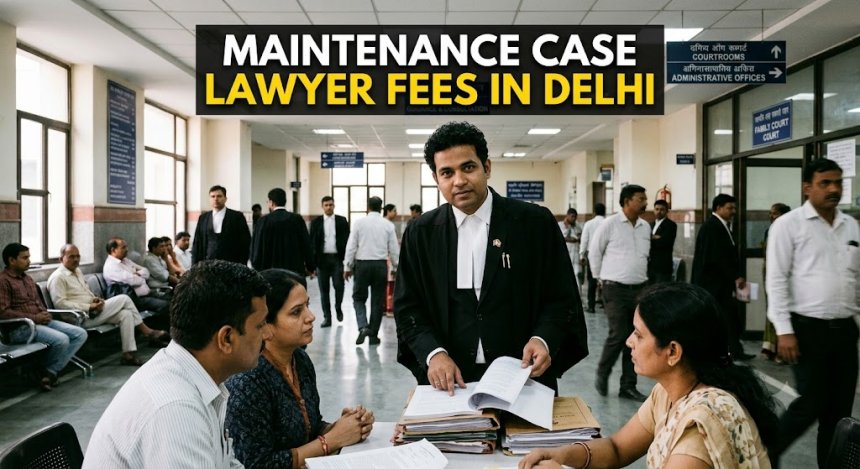
Maintenance Case Lawyer Fees in Delhi
Complete guide to maintenance case lawyer fees in Delhi: filing, court appearances, hidden legal costs, BNSS laws, and practical court procedures.

⚖️ HOW LONG WILL YOU STAY SILENT?
📞 Call Karke Advocate Ko Apni Legal Problem Batayein.
Poochhne Mein Koi Nuksan Nahi Hota.
Ek Baatcheet Aapko Sahi Kanooni Disha Dikha Sakti Hai.
Speak to a Supreme Court Advocate Today.
Talk or Message in Any Language.
⚖️ HOW LONG WILL YOU STAY SILENT?
📞 Call Karke Advocate Ko Apni Legal Problem Batayein.
Poochhne Mein Koi Nuksan Nahi Hota.
Any Language Supported
Maintenance Case Lawyer Fees in Delhi: Filing, Court Appearance & Legal Costs
When a marriage or domestic relationship breaks down, financial dependency and legal battles over maintenance often emerge as the most contested issues before the courts. In matrimonial disputes across District Courts and Family Courts in Delhi—such as Saket, Tis Hazari, Patiala House, Rohini, Dwarka, and Karkardooma—one of the earliest questions clients ask is: How much will this litigation actually cost?
Understanding the financial commitment required to navigate a maintenance dispute is critical. Litigants frequently find themselves caught between unexpected legal charges, ambiguous billing structures, protracted court delays, and conflicting advice. This guide breaks down the practical reality of Maintenance Case Lawyer Fees in Delhi: Filing, Court Appearance & Legal Costs, the applicable statutory provisions under Indian law, standard step-by-step procedures, documentation mandates, hidden courtroom expenses, and strategies to protect your financial and legal interests.
Understanding the Problem: Why Maintenance Disputes Arise
Maintenance (or spousal and child support) under Indian law is not designed as a punitive measure; it is a statutory remedy intended to prevent vagrancy, secure basic livelihoods, and ensure that dependent spouses, children, or elderly parents maintain a standard of living reasonably aligned with the economic status enjoyed during the subsistence of the relationship.
Common Situations That Lead to Legal Filings
-
Sudden Financial Abandonment: A earning spouse abruptly ceases financial support for household expenses, children's school fees, medical care, or rent following marital discord.
-
Concealment of Real Income: A spouse claims low income, business losses, or joblessness to evade statutory obligations, while operating profitable businesses, earning through cash transactions, or holding undisclosed liquid assets.
-
Multiplicity of Litigation: Maintenance claims are frequently filed concurrently across distinct forums—such as under criminal procedure remedies, domestic violence legislation, and regular civil/divorce petitions.
-
Disputes Over Child Upbringing: Non-custodial parents sometimes refuse to contribute equitably to inflated extracurricular, private tutoring, or lifestyle costs demanded by the custodial parent.
A Real-Life Practical Scenario
Consider a situation in Delhi where a wife leaves the matrimonial home in Dwarka due to alleged domestic discord. The husband, employed as a mid-level corporate executive, stops transferring funds for her personal expenses and their minor child’s school tuition. The wife approaches a Family Court for interim financial assistance.
Simultaneously, the husband, fearing substantial financial deductions, submits basic salary slips while suppressing annual performance bonuses, stock options, and rental income from an ancestral property. Without meticulous drafting, bank tracking, and a rigorous forensic income affidavit, the court risks awarding an unbalanced interim amount. Conversely, if an unemployed husband facing genuine medical or career distress is slapped with an exorbitant maintenance demand based on inflated claims, proper legal defence is necessary to avert unreasonable financial liabilities and potential enforcement warrants.
What Does Indian Law Say? (Governing Provisions Explained)
Maintenance laws in India operate across civil, criminal, and personal law frameworks. Litigants in Delhi frequently seek relief or face claims under one or more of the following statutory provisions:
                          ┌────────────────────────────────────────────────────────┐
                          │         Statutory Maintenance Frameworks               │
                          └───────────────────────────┬────────────────────────────┘
                                                      │
         ┌────────────────────────────────────────────┼────────────────────────────────────────────┐
         ▼                                            ▼                                            ▼
┌─────────────────────────────────┐          ┌─────────────────────────────────┐          ┌─────────────────────────────────┐
│       BNSS, 2023 (Sec. 144)     │          │         DV Act, 2005            │          │    Personal Laws (HMA / SMA)    │
│  • Secular & summary remedy     │          │  • Sec. 20 (Monetary relief)    │          │  • HMA Sec. 24 (Interim relief) │
│  • Replaces old Sec. 125 CrPC   │          │  • Sec. 22 (Compensation)       │          │  • HMA Sec. 25 (Permanent)      │
│  • Protects wife, child, parent │          │  • Runs before MM courts        │          │  • Applicable during divorce    │
└─────────────────────────────────┘          └─────────────────────────────────┘          └─────────────────────────────────┘
1. Section 144 of the Bharatiya Nagarik Suraksha Sanhita, 2023 (BNSS)
(Formerly Section 125 of the Code of Criminal Procedure, 1973 - CrPC)
-
Scope: A secular, summary provision available to all individuals regardless of their personal religious affiliations.
-
Entitlement: Covers wives (including divorced wives who have not remarried), legitimate or illegitimate minor children, physically or mentally dependent adult children, and parents unable to maintain themselves.
-
Core Principle: Designed for immediate, urgent relief to prevent financial destitution.
2. Protection of Women from Domestic Violence Act, 2005 (DV Act)
-
Scope: Filed before the Metropolitan Magistrate (Mahila Court).
-
Section 20 & 22: Allows an aggrieved woman to claim monetary relief, loss of earnings, medical expenses, maintenance for herself and children, and additional damages for emotional distress.
-
Section 19: Empowers the court to grant residence orders or mandate rent reimbursement in lieu of alternate accommodation.
3. Hindu Marriage Act, 1955 (HMA)
-
Section 24 (Interim Maintenance & Legal Expenses): Allows either the wife or husband (who has no independent income sufficient for their support) to seek monthly interim support and actual litigation expenses during the pendency of main matrimonial proceedings (e.g., divorce or restitution of conjugal rights).
-
Section 25 (Permanent Alimony & Maintenance): Deals with final financial settlements and monthly or lump-sum orders at the time of passing a final matrimonial decree.
4. Special Marriage Act, 1954 (SMA)
-
Sections 36 & 37: Mirrors the provisions of the Hindu Marriage Act for civil or inter-faith marriages registered under the SMA, allowing wives to seek interim litigation expenses and permanent alimony upon dissolution of marriage.
5. Supreme Court Benchmarks: Rajnesh v. Neha (2020)
The Supreme Court of India laid down mandatory pan-India guidelines governing maintenance disputes:
-
Standardized Disclosure: Both parties must mandatorily file detailed affidavits disclosing all global assets, bank accounts, monthly expenditures, debts, and income sources.
-
Date of Order Application: Maintenance is payable from the date of filing the application, preventing deliberate delay tactics by the paying party.
-
Adjustment & Overlapping: While a claimant can apply under multiple statutes (e.g., BNSS, DV Act, HMA), the court must adjust and set off amounts to avoid double financial recovery from the paying spouse for the same period.
Step-by-Step Legal Process in Delhi Family Courts
Understanding the lifecycle of a maintenance matter in Delhi helps litigants manage expectations, prepare for timelines, and budget their legal expenses efficiently:
[Step 1: Drafting & Verification]
        │
        ▼
[Step 2: Filing & Scrutiny in District Filing Counter]
        │
        ▼
[Step 3: First Listing & Summons/Notice to Respondent]
        │
        ▼
[Step 4: Mandatory Family Court Mediation Centre Referral]
        │
        ├─── If Settled ──► [Consent Decree / Settlement Deed Drawn]
        │
        └─── If Mediation Fails ──► [Step 5: Filing Assets & Liabilities Affidavits]
                                          │
                                          ▼
                                    [Step 6: Interim Maintenance Arguments & Order]
                                          │
                                          ▼
                                    [Step 7: Evidence Stage (Cross-Examination)]
                                          │
                                          ▼
                                    [Step 8: Final Arguments & Final Maintenance Decree]
                                          │
                                          ▼
                                    [Step 9: Execution Petition (If Defaulted)]
Step 1: Legal Consultation & Case Drafting
The advocate gathers facts, assesses whether to invoke Section 144 BNSS, Section 12 DV Act, or Section 24 HMA, and drafts the substantive petition along with an application for interim maintenance.
Step 2: Filing & Registry Scrutiny
The petition is verified, attested by an Oath Commissioner, and submitted to the centralized filing counter of the relevant Delhi District Court (e.g., Saket, Tis Hazari, Patiala House, Rohini, Karkardooma, or Dwarka). The registry checks for procedural objections/defects before assigning a court number.
Step 3: First Listing & Issuance of Notice
The matter appears before the Principal Judge or Additional Principal Judge (Family Court) or Metropolitan Magistrate. Upon hearing initial submissions, the court issues formal summons/notice to the respondent spouse via registered post, speed post, courier, and electronic means (WhatsApp/Email).
Step 4: Mandatory Mediation Reference
Under Section 9 of the Family Courts Act, 1984, the court routinely directs both parties to the attached Court Mediation Centre on the initial returnable date to explore an amicable settlement or composite mutual divorce terms.
Step 5: Filing Written Statement & Asset Affidavits
If mediation yields no resolution, the respondent must file a Written Statement (reply). Crucially, both parties are directed to file their Comprehensive Affidavit of Assets and Liabilities complying with the Rajnesh v. Neha judgment.
Step 6: Hearing & Order on Interim Maintenance
The court hears oral arguments strictly focused on the interim application, relying on the filed affidavits, salary slips, and income tax returns (ITRs). The judge passes an Interim Maintenance Order, fixing a monthly sum effective from the date of filing until the final conclusion of the case.
Step 7: Evidence Stage & Cross-Examination
Both parties submit formal Evidence Affidavits. The respective advocates conduct oral cross-examination of the husband and wife to test the veracity of their earnings, expenditure claims, and conduct.
Step 8: Final Hearing & Judgment
The court reviews the recorded evidence, evaluates legal precedents, and pronounces a final judgment determining permanent or ongoing maintenance.
Step 9: Enforcement & Execution Proceedings
If the paying party defaults on the interim or final order, the applicant files an Execution Petition under Section 147 BNSS (or Order XXI CPC / Section 28A Family Courts Act). The court may issue attachment orders against bank accounts, attach salaries, seize movable/immovable assets, or issue bailable/non-bailable warrants leading to civil imprisonment.
Documents Required for a Maintenance Petition
To build a legally sound maintenance petition or to defend against inflated claims, concrete documentary substantiation is essential.
| Document Category | Document Name | Practical Legal Purpose |
| Mandatory Documents | Aadhaar Card / Voter ID / Passport | Proof of identity, legal age, and residential jurisdiction in Delhi. |
| Mandatory Documents | Marriage Proof (Marriage Certificate / Photos / Card) | Establishes the existence of a legally valid marital relationship. |
| Mandatory Documents | Affidavit of Assets and Liabilities (Rajnesh v. Neha) | Compulsory detailed disclosure of all earnings, debts, lifestyle costs, and bank balances. |
| Mandatory Documents | Income Proof (ITRs for last 3 years, Form 16) | Demonstrates actual taxable income and historical earning capacity. |
| Mandatory Documents | Bank Statements (All active accounts for last 3 years) | Uncovers financial transfers, undisclosed lifestyle spending, investments, and cash flow. |
| Optional / Case Specific | Children's School Fee Receipts & Medical Records | Substantiates actual monthly child upkeep and special care expenses. |
| Optional / Case Specific | Rental Agreement / Rent Receipts / Utility Bills | Proves monthly living overheads and shelter expenses if living separately. |
| Optional / Case Specific | Loan Statements / EMI Repayment Schedules | Establishes fixed non-discretionary liabilities of the paying spouse. |
| Supporting Evidence | Social Media Records / Travel Tickets / Asset Pictures | Evidences actual lifestyle and standard of living when formal income is suppressed. |
| Supporting Evidence | Medical Prescriptions / Chronic Illness Proof | Justifies heightened financial dependency or medical inability to seek employment. |
Typical Timelines and Potential Delays in Delhi
While the statute aims for summary disposal, realistic court timelines in high-volume metropolitan jurisdictions like Delhi involve several phases:
-
Interim Maintenance Disposal: Statutorily expected within 60 days of notice; practically takes 4 to 9 months across Delhi Family Courts due to mediation sessions, delayed asset affidavits, and contested replies.
-
Full Case Trial & Final Judgment: Spans 1.5 to 3.5 years depending on the speed of witness cross-examination and court pendency.
-
Execution & Arrears Recovery: Takes 3 to 12 months depending on the respondent’s compliance and whether distress warrants or salary attachments are required.
Key Factors Causing Procedural Delays
-
Service Evasion: The respondent repeatedly avoids receiving summons, necessitating substituted service (publication in local newspapers).
-
Defective Income Disclosures: Failure by either party to file the asset affidavit in proper format, leading to repeated judicial warnings and adjournments.
-
Overcrowded Daily Cause Lists: Heavy caseloads in Delhi district complexes often push substantive argument dates back by 6 to 10 weeks per listing.
-
Appeals & Revisions: Interlocutory challenges against interim maintenance orders filed before the Delhi High Court (under Article 227 or criminal revision).
Fees Explained: Maintenance Case Lawyer Fees in Delhi & Legal Costs
Legal costs in matrimonial litigation are not uniform. The Bar Council of India prohibits fee guarantees, and professional rates depend directly on lawyer experience, case complexity, the forum involved, and litigation longevity.
Advocate fees vary depending on the complexity of the matter, court involved, urgency, documentation, experience of the lawyer, and location.
Understanding the components of legal expenditure provides complete clarity on what you are paying for:
                      ┌──────────────────────────────────────────────────────────┐
                      │             Total Litigation Cost Structure              │
                      └────────────────────────────┬─────────────────────────────┘
                                                   │
         ┌─────────────────────────────────────────┼─────────────────────────────────────────┐
         ▼                                         ▼                                         ▼
┌──────────────────────────────┐          ┌──────────────────────────────┐          ┌──────────────────────────────┐
│       Government Costs       │          │       Advocate Fees          │          │    Miscellaneous Costs       │
│  • Court Fees (Nominal)      │          │  • Consultation & Advisory   │          │  • Printing & Clerical       │
│  • Process / Summons Fee     │          │  • Drafting Main Petition    │          │  • Forensic CA Audit         │
│  • Certified Copies          │          │  • Appearance (Per Date/Pkg) │          │  • Process Server / SpeedPost│
└──────────────────────────────┘          └──────────────────────────────┘          └──────────────────────────────┘
1. Court Fees & Government Stamp Duties
-
Criminal Maintenance (Sec 144 BNSS / 125 CrPC): Incurs minimal court fee stamps (typically ₹5 to ₹50 nominal stamp duty).
-
DV Act Applications: Nominal process fees and nominal court fees.
-
HMA Sec 24 / Sec 25 Applications: Requires nominal miscellaneous application court fees (₹10 to ₹100), as it arises within the main matrimonial suit.
2. Drafting & Documentation Expenses
Drafting a robust maintenance petition along with the complex Rajnesh v. Neha financial disclosure affidavit requires extensive document review, financial reconciliation, and strategic articulation.
-
Estimated Range in Delhi: ₹15,000 to ₹50,000 (depending on the advocate's expertise and volume of corporate/financial records involved).
3. Advocate Professional Fee Models
Lawyers and law firms in Delhi typically charge under one of three structures:
-
Stage-by-Stage / Package Fee: A consolidated fee covering the entire case up to interim orders, followed by a separate tranche for the trial/evidence stage and final disposal.
-
Estimated Range for Stage Packages: ₹40,000 to ₹1,50,000+ per major legal stage.
-
-
Per-Appearance Billing: An initial drafting and retainer charge followed by a fixed fee for each physical or virtual court appearance.
-
Estimated Range per Court Appearance: ₹3,500 to ₹25,000+ per hearing, depending on the seniority of the counsel.
-
-
Comprehensive End-to-End Retainer: Covers the entire dispute (excluding high court appeals or complex execution matters).
-
Estimated Range: ₹75,000 to ₹3,00,000+.
-
4. Incidental & Miscellaneous Expenses
-
Affidavits & Notary Charges: ₹500 to ₹2,000 per set of filings.
-
Process Server / Speed Post Fees: ₹200 to ₹1,500 for serving notices across multiple addresses.
-
Certified Copies & Daily Order Sheets: ₹500 to ₹3,000 throughout the case duration.
-
Private Investigation / Forensic Document Tracing (If opted): Variable costs if engaged to track suppressed assets or undisclosed company directorships.
Hidden Truths People Don't Know About Maintenance Cases
Matrimonial litigation involves practical court realities that are rarely disclosed in initial textbook overviews:
1. The Trap of False Income Claims
Litigants often believe that transferring salary accounts to cash or resigning from official directorships completely frees them from maintenance liabilities. Delhi courts routinely apply the doctrine of Earning Capacity; if a qualified professional deliberately leaves their job or shows zero income without medically verified incapacitation, the court estimates income based on qualifications and past employment history.
2. Deliberate Under-Reporting of Assets
Hiding assets in the Rajnesh v. Neha affidavit is a double-edged sword. If the opposing advocate successfully cross-checks hidden accounts using bank PAN linkages, credit card summaries, or MCA director filings, the court draws an adverse inference and may initiate perjury proceedings under Section 340 CrPC (Section 379 BNSS).
3. The Backlog of Arrears
Because maintenance is calculated from the date of initial application filing, long delays by the paying spouse accumulate a substantial debt burden. A case delayed by 18 months with an eventual interim order of ₹30,000 per month instantly generates an enforceable arrears debt of ₹5,40,000 payable immediately or in court-structured installments.
4. Overlapping Petitions Must Be Harmonised
Filing for maintenance across the Mahila Court (under the DV Act) and the Family Court (under Section 144 BNSS and Section 24 HMA) is permissible, but non-disclosure of an existing order in another court is an abuse of process. The applicant must adjust the sums to ensure transparency.
5. Execution Is Where Real Effort Lies
Securing an order is only half the battle. If a respondent stubbornly ignores orders, the advocate must initiate rigorous execution measures—attaching bank balances, seizing vehicles, or moving for civil custody.