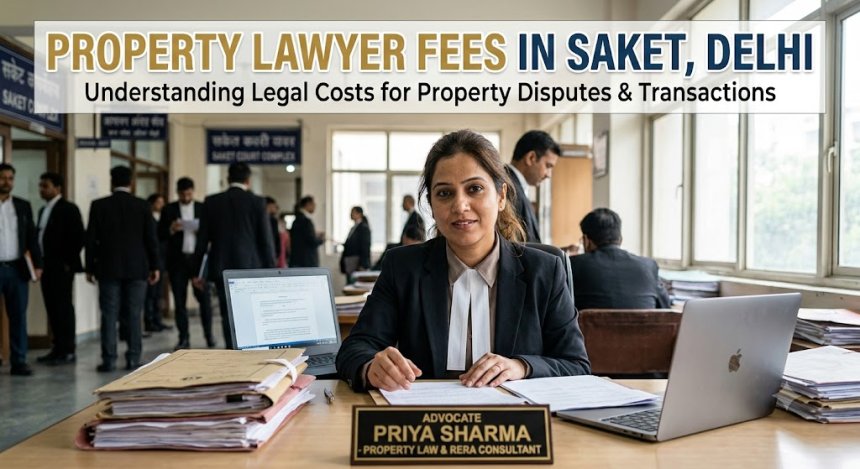
Property Lawyer Fees in Saket, Delhi
Complete breakdown of property lawyer fees in Saket, Delhi. Understand drafting, title search, litigation costs, court fees, and key legal processes.Slug: property-lawyer-fees-saket-delhi

⚖️ HOW LONG WILL YOU STAY SILENT?
📞 Call Karke Advocate Ko Apni Legal Problem Batayein.
Poochhne Mein Koi Nuksan Nahi Hota.
Ek Baatcheet Aapko Sahi Kanooni Disha Dikha Sakti Hai.
Speak to a Supreme Court Advocate Today.
Talk or Message in Any Language.
⚖️ HOW LONG WILL YOU STAY SILENT?
📞 Call Karke Advocate Ko Apni Legal Problem Batayein.
Poochhne Mein Koi Nuksan Nahi Hota.
Any Language Supported
Property Lawyer Fees in Saket, Delhi: A Practical Cost, Process & Legal Guide
Dealing with real estate transactions or resolving a landed dispute in South Delhi comes with distinct legal nuances. Whether buying a floor in Greater Kailash, inheriting an ancestral house in Malviya Nagar, or resolving a boundary conflict in Mehrauli, engaging legal counsel is often essential.
A primary concern for clients is understanding Property Lawyer Fees in Saket, Delhi. Property legal costs are rarely a single, fixed figure. Fees depend on the nature of the transaction, title clarity, registration requirements, or whether the matter involves active litigation at the Saket District Court Complex.
This practical guide breaks down legal expenses, government charges, documentation requirements, procedural timelines, and critical realities of hiring a property advocate in Saket.
The Reality of Property Transactions and Disputes in South Delhi
South Delhi real estate is among the most valuable in India, covering upscale residential colonies, DDA housing schemes, lal dora land, and commercial hubs. The high stakes make transactions susceptible to complications:
-
Builder-Buyer Disagreements: Delayed possession, unauthorized construction exceeding sanctioned FAR (Floor Area Ratio), or unapproved terrace usage.
-
Inheritance and Partition Conflicts: Ambiguous wills, multiple legal heirs asserting conflicting claims, or partition disputes among siblings.
-
Title Irregularities: Forged chains of title, unrecorded family settlements, unexecuted conveyance deeds, or sales based solely on General Power of Attorney (GPA) agreements.
-
Encroachment and Illegal Possession: Trespassing or refusal by long-term tenants to vacate premises.
+-----------------------------------------------------------------------------------+
| Example: The GPA Trap                                                             |
| A buyer purchases a builder floor in Neb Sarai relying on GPA and Agreement       |
| to Sell without a registered Sale Deed. When applying for mutation or a bank     |
| loan, the title is flagged as defective. Resolving this often requires extensive  |
| title verification and civil litigation at Saket Court to regularize ownership.   |
+-----------------------------------------------------------------------------------+
Key Indian Property Laws Governing Real Estate
Property transactions and litigation are governed by foundational central and state-level statutes:
-
The Transfer of Property Act, 1882: Governs the sale, mortgage, lease, exchange, and gift of immovable property. Section 54 mandates that any tangible immovable property valued over ₹100 must be transferred via a registered instrument.
-
The Registration Act, 1908 & The Indian Stamp Act, 1899: Prescribe mandatory registration and stamp duty payments for real estate transactions to establish valid legal title.
-
The Real Estate (Regulation and Development) Act, 2016 (RERA): Protects buyers from unfair builder practices, delays, and structural defects.
-
The Specific Relief Act, 1963: Governs suits for specific performance (compelling a party to execute a registered sale deed) and recovery of possession.
-
Bharatiya Nyaya Sanhita, 2023 (BNS): Addresses criminal aspects of property disputes, such as fraudulent property sales, forgery of title documents, and criminal trespass.
-
Delhi Land Reforms Act, 1954 & Delhi Municipal Corporation (MCD) Act: Govern land use, rural/urban classification, and building bye-laws across South Delhi.
Step-by-Step Legal Process for Property Matters
Property legal processes generally follow one of two paths: non-contentious transactions (due diligence and registration) or contentious civil litigation.
Transactional Process:
[Title Search & Document Collection] ➔ [Encumbrance Verification] ➔ [Drafting Legal Instrument] ➔ [Sub-Registrar Registration]

Litigation Process (Saket Court):
[Legal Notice Sent] ➔ [Plaint Filed at Saket Court] ➔ [Summons Issued] ➔ [Written Statement & Issues] ➔ [Evidence & Final Arguments]
Non-Litigation (Transactional Due Diligence & Registration)
-
Document Collection & 30-Year Title Search: The advocate inspects the chain of title for at least 30 years at the Sub-Registrar’s office (e.g., Mehrauli, Hauz Khas, or Saket).
-
Encumbrance Verification: Verifying pending litigation, bank mortgages, attachment orders, or statutory dues with local authorities.
-
Drafting the Instrument: Preparing a customized Sale Deed, Gift Deed, Relinquishment Deed, or Lease Agreement with specific indemnity clauses.
-
Stamp Duty Calculation and e-Stamping: Procuring non-judicial e-stamp papers based on applicable circle rates.
-
Execution at the Sub-Registrar Office: Accompanying parties to the relevant Sub-Registrar office for biometric verification, witness testimony, and registration.
Property Litigation at Saket Court
-
Issue of Legal Notice: Serving a formal demand or notice of dispute before filing a court claim.
-
Filing the Plaint: Submitting the plaint, accompanied by supporting affidavits and court fees, before the Senior Civil Judge or District Judge at Saket Court.
-
Summons and Written Statement: The court issues summons to the opposite party, who must submit a Written Statement within 30 to 120 days.
-
Interim Relief / Injunction: Seeking temporary injunctions under Order 39 of the CPC to prevent property alienation or unauthorized construction.
-
Admission/Denial & Framing of Issues: Formal inspection of documents and establishment of legal points for trial.
-
Evidence and Cross-Examination: Recording testimonies of witnesses and cross-examining opposing parties.
-
Final Arguments and Decree: Delivery of the formal judgment and decree, followed by execution proceedings under Order 21 of the CPC if necessary.
Documents Required for Property Due Diligence & Litigation
| Document Category | Document Name | Purpose & Legal Significance |
| Mandatory | Registered Mother Deed / Chain Deeds | Proves ownership continuity over the statutory 30-year period. |
| Mandatory | Current Sale Deed / Conveyance Deed | Primary proof of ownership of the current seller/transferor. |
| Mandatory | Identity and Address Proofs (Aadhaar / PAN) | Required for verification, e-stamping, and court identification. |
| Mandatory | Sanctioned Building Plan | Confirms construction complies with MCD/DDA regulations. |
| Supporting | Encumbrance Certificate (Form 15/16) | Confirms the property is free from mortgages or legal dues. |
| Supporting | Property Tax Receipts & Mutation Records | Demonstrates recorded physical possession and payment of civic dues. |
| Supporting | NOC from RWA / Society / DDA | Confirms no outstanding arrears or local development objections. |
| Optional / Case-Specific | Registered Will / Probate / Succession Certificate | Mandatory for legitimizing inherited property claims. |
| Optional / Case-Specific | General Power of Attorney (GPA) | Establishes authorized agency when dealing with representative owners. |
Timelines for Property Matters in Delhi
-
Title Search & Due Diligence Report: 3 to 7 business days.
-
Drafting and Sub-Registrar Registration: 1 to 3 business days following document finalization.
-
DDA / MCD Mutation Formalities: 30 to 60 business days.
-
Injunction / Stay Orders at Saket Court: 15 to 45 days, depending on urgency and court scheduling.
-
Full Civil Litigation (Partition, Title Suit, Eviction): 2 to 5 years, depending on witness availability, interlocutory appeals, and case complexity.
Detailed Breakdown: Property Lawyer Fees in Saket, Delhi
Legal Disclaimer: Advocate fees vary depending on the complexity of the matter, court involved, urgency, documentation requirements, experience of the lawyer, and specific location within South Delhi.
+------------------------------------------------------------------------------------+
| Typical Cost Components:                                                           |
| • Initial Legal Consultation           • Due Diligence & Title Search Reports      |
| • Drafting Deeds and Contracts          • Registration Assistance                   |
| • Civil Court Litigation               • Government Stamp Duty & Ad-Valorem Fees   |
+------------------------------------------------------------------------------------+
Indicative Professional Fee Structures
-
Legal Consultation: ₹1,500 to ₹5,000 for an initial case assessment and document review.
-
Title Verification & Legal Search Report: ₹10,000 to ₹35,000, depending on the property's age and document chain length.
-
Drafting Legal Deeds (Sale, Gift, Relinquishment): ₹7,500 to ₹25,000 per instrument.
-
Sub-Registrar Representation & Registration: ₹10,000 to ₹30,000 for registration assistance.
-
Issuing a Legal Notice: ₹5,000 to ₹15,000.
-
Civil Litigation (Partition, Injunction, Specific Performance): May be structured as a lump-sum engagement (₹75,000 to ₹3,50,000+) or billed per hearing (₹5,000 to ₹25,000 per appearance), depending on counsel seniority and dispute complexity.
Court & Statutory Government Expenses
-
Delhi Court Fees: Civil suits require court fees calculated on the claim's valuation under the Court Fees Act, 1870 (as applicable to Delhi), subject to statutory caps.
-
Stamp Duty on Property Registration in Delhi:
-
Male Buyers: ~6% of circle rate or consideration amount.
-
Female Buyers: ~4% of circle rate or consideration amount.
-
Joint Ownership: ~5%.
-
Mandatory Sub-Registrar Fee: Additional 1% of total transaction value.
-
Practical Realities of Property Disputes in South Delhi
-
GPA Transactions Lack Legal Title: Relying on GPA sales without registered conveyance does not confer ownership under Indian law (Suraj Lamp & Industries Pvt. Ltd. v. State of Haryana). Converting these matters into marketable titles requires corrective deeds or declaratory suits.
-
Interim Injunctions are Decisive: In partition or eviction suits, obtaining a timely interim stay order prevents the opposing party from selling or altering the property during litigation.
-
Sub-Registrar Jurisdiction Matters: Property registration must occur at the specific Sub-Registrar office overseeing that zone (e.g., SR-V Mehrauli, SR-IV Hauz Khas).
-
Settlement Often Saves Years of Litigation: Many civil disputes resolve favorably through court-annexed mediation at Saket Court, avoiding years of trial while yielding an enforceable consent decree.
Common Property Mistakes to Avoid
-
Skipping Due Diligence: Purchasing property based solely on verbal trust without a 30-year search.
-
Using Generic Internet Templates: Using generic deed templates that lack specific indemnity or title warranties.
-
Relying on Unregistered Wills: Transferring high-value property without formal probate or succession orders where title is contested.
-
Miscalculating Stamp Duty: Using outdated circle rate brackets, which risks penalties during Sub-Registrar assessment.
-
Ignoring Municipal Sanction Plans: Purchasing unapproved top floors or stilt conversions vulnerable to MCD sealing.
-
Delaying Injunction Filings: Waiting until third-party rights are created before seeking court intervention.
-
Overlooking Local Tenancy Terms: Evicting long-term tenants without observing statutory notice requirements.
-
Failing to Update Municipal Records: Forgetting to complete MCD property tax mutation after registered deed execution.
-
Not Registering Family Settlements: Relying on informal handwritten family arrangements without proper legal execution.
-
Delaying Professional Legal Intervention: Involving an advocate only after signing non-refundable earnest money agreements.
When Should You Hire a Property Advocate?
Hire an advocate immediately if:
✔ You are signing an Agreement to Sell or depositing token money.
✔ You encounter overlapping ownership claims on ancestral property.
✔ A builder fails to deliver possession within the committed timeline.
✔ An adjoining owner encroaches on your boundary or common areas.
✔ You receive a formal legal notice regarding title, tenancy, or partition.
Frequently Asked Questions
What factors directly influence property lawyer fees in Saket, Delhi? Fees depend on document volume, property market value, procedural complexity, whether the matter involves out-of-court drafting or litigation, and the advocate's years of practice.
Can a property lawyer in Saket assist with out-of-court settlements? Yes. Advocates routinely handle structured negotiations, family settlement deeds, and court-annexed mediation at Saket District Court.
Is physical presence required at the Sub-Registrar office during registration? Yes. Both parties (or their authorized GPA holders) must appear for biometric scanning, photograph verification, and witness signatures.
What is the difference between a Title Search Report and an Encumbrance Certificate? An Encumbrance Certificate lists registered financial liabilities. A Title Search Report is a comprehensive legal review by an advocate evaluating ownership continuity, mutation validity, legal heir claims, and litigation risks.
How is court fee calculated for property disputes at Saket Court? Court fee is assessed under the Court Fees Act based on the suit's valuation, calculated on the market value of the property or the specific relief claimed.
Does a General Power of Attorney grant complete ownership of Delhi property? No. The Supreme Court has ruled that GPA transactions do not confer ownership title without an executed, registered Conveyance or Sale Deed.
Can an advocate represent me at the Sub-Registrar office? Advocates assist with preparation, verification, stamping, and accompanying clients during presentation, though the primary parties must appear for biometric identification.
How can I verify if a property in South Delhi is free from MCD sealing orders? An advocate verifies municipal compliance by checking the sanctioned building plan against the physical layout and reviewing MCD records for demolition or sealing notices.
What should I do if a co-owner refuses to sell or divide ancestral property? You can file a Suit for Partition and Separate Possession before the competent Civil Court at Saket District Courts.
How long does an injunction order take in a property emergency? Depending on urgency, an interim application under Order 39 of the CPC can be heard within a few days of filing.